daltrey: Public RFP Triage
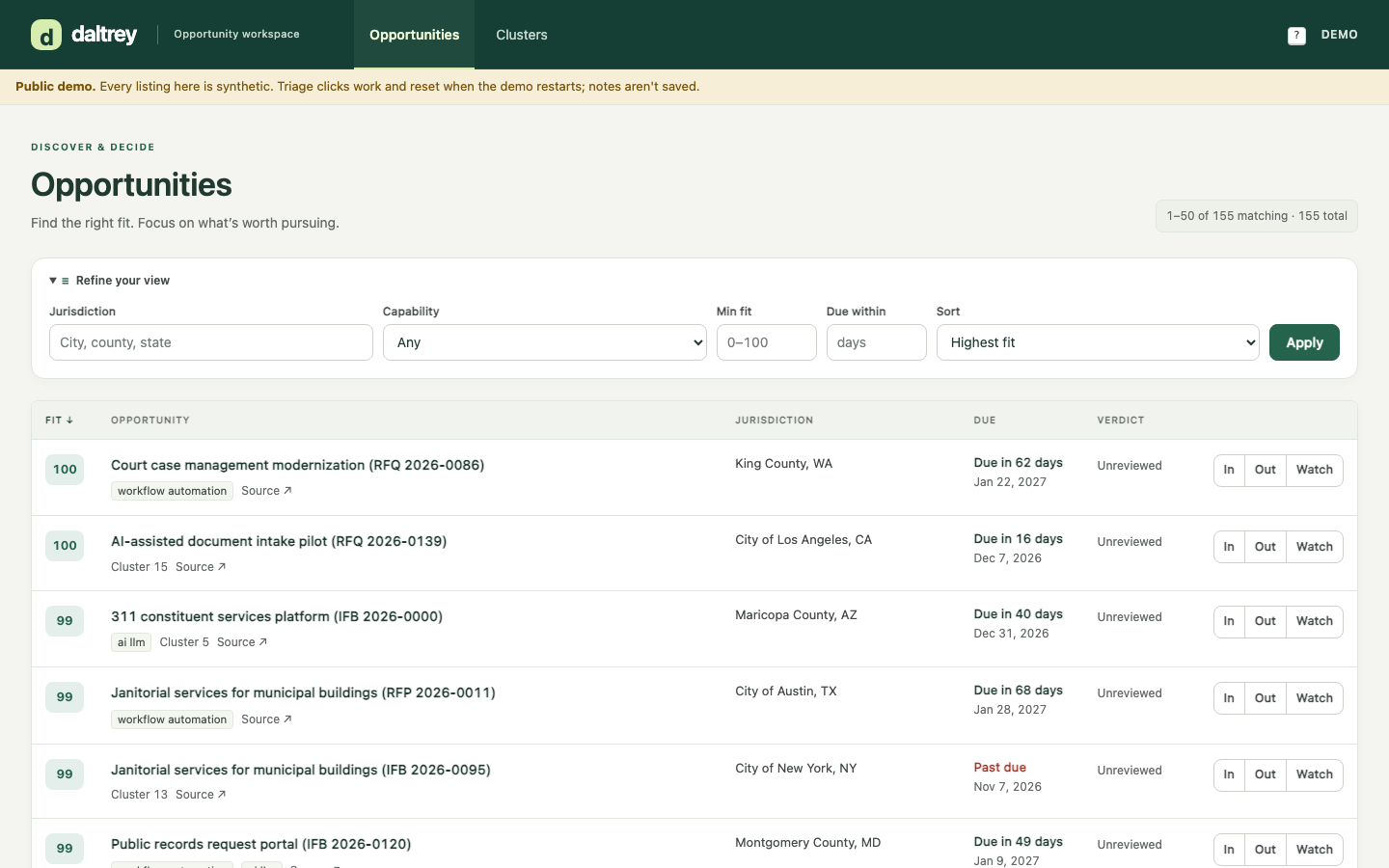
daltrey ingests requests for proposals from local-government open-data feeds (four in production, with two more wired in just before it was archived), normalizes and dedupes them, and asks Claude Haiku to score each one against a versioned capability profile. A local embedding model then clusters similar requests across jurisdictions, so the same records portal requested in three cities would show up as one cluster. Every stage is idempotent and can be rerun on its own, every score records the model and a hash of the prompt behind it, and spend is estimated before a run: the full backfill was priced at about $7.30 for 2,753 listings before it was approved. People make every in, out, or watch decision. The public demo runs on invented listings, so triage clicks work but nothing real is shown.
What it proves
A cost-governed language-model pipeline that ran in production: ingest, dedupe, model scoring, embedding clustering, and human review, with spend estimated before it happens.
How it was built
With market research by Jim Riley. Claude Code through the ROCRLL loop: tests first against recorded fixtures, an adversarial review on every pull request, and every trade-off logged in a decision record.
What is real, and where I was learning
What is real: ingest, scoring, and clustering ran in production, producing 2,739 assessments and 14 clusters, 7 of them spanning more than one jurisdiction. Where it stopped: the later phases (briefs, outreach drafts, prototypes) were never built, and the project was archived on 2026-11-01. Jim Riley contributed the market research, and the repo is private.